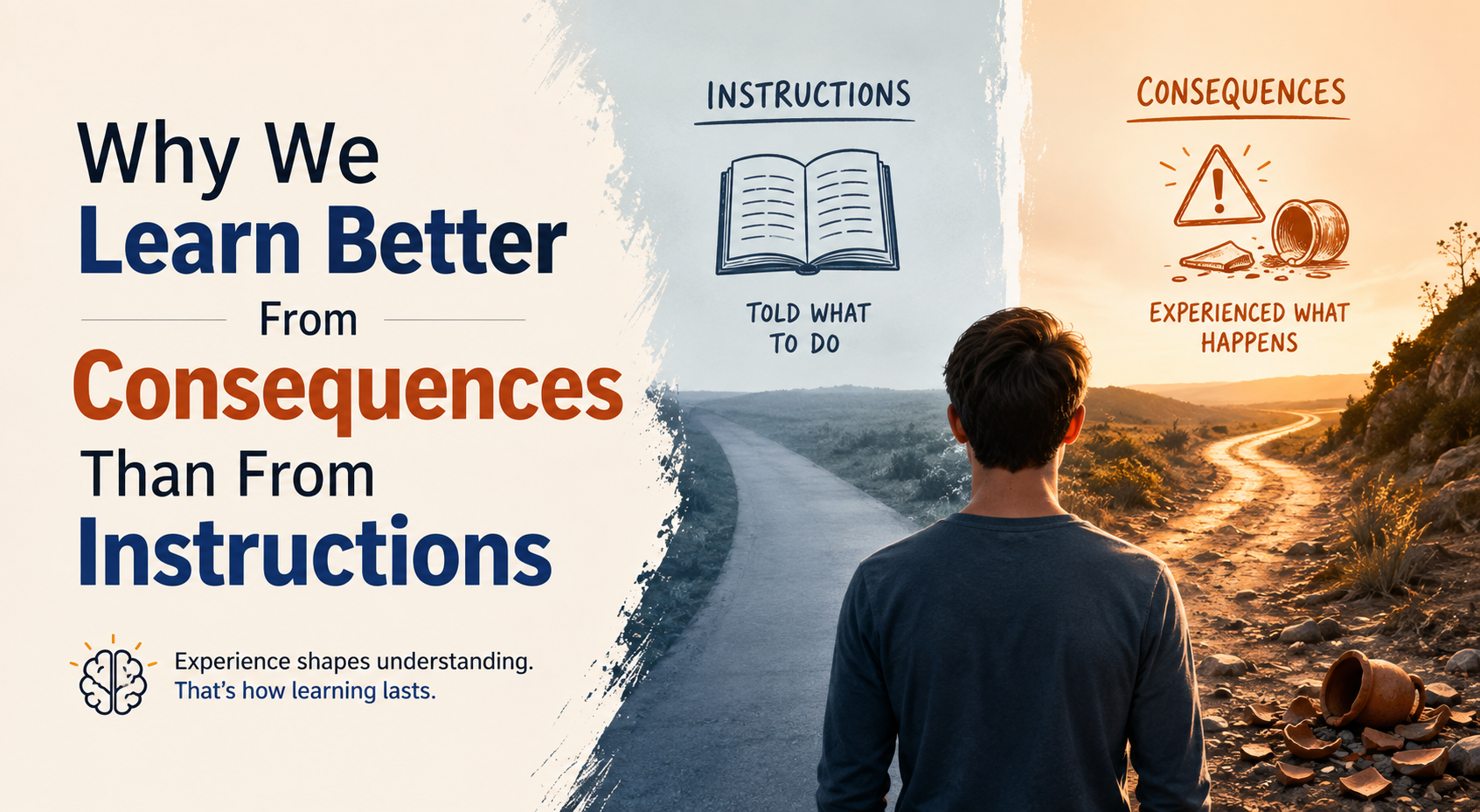
Quick answer: People retain skills faster and longer when they experience the outcome of a decision than when they're simply told the "right" answer. This is because consequences trigger emotional memory, active problem-solving, and immediate feedback loops three things static instructions can't provide. It's why nobody forgets how to ride a bike, but almost everyone forgets a lecture on the same day they hear it.
This idea isn't just a teaching philosophy it's backed by decades of learning science, and it's the entire reason games are quietly becoming one of the most effective tools for teaching real-life skills.
The Bike Problem: Why Instructions Alone Don't Stick
Think about the last time someone taught you something purely through explanation a manual, a slideshow, a lecture. Now think about the last time you learned something by doing it, getting it wrong, and adjusting.
Chances are, you can barely remember the lecture. But you can still ride a bike.
Nobody learns to ride a bike by reading about balance and pedaling technique. You get on, you wobble, you fall, and your brain files away exactly what "too far left" feels like. That failure and the very next correction is the lesson. Instructions can tell you the theory. Only consequences teach you the feel.
The same gap shows up everywhere skills actually matter:
- Budgeting - reading "don't overspend on non-essentials" means nothing until you've watched a paycheck run out before rent is covered.
- Hard conversations - being told "stay calm and listen" is forgettable until you've picked the wrong reply and watched a conversation blow up.
- Job interviews - a checklist of "good answers" doesn't prepare you the way seeing a hiring manager's score drop in real time does.
The Science: Why Consequences Beat Instructions
1. Consequences create emotional memory
Memory researchers have long shown that emotionally charged experiences are encoded more strongly than neutral information. A worksheet about budgeting is neutral. Watching your simulated paycheck run out before you've paid rent is not it produces a small jolt of stress that makes the lesson stick.
2. Feedback loops close the gap between action and understanding
Instructions are one-directional: someone tells you a rule, and you're expected to internalize it before ever testing it. Consequences are a loop you act, you see the result, you adjust, you act again. That tight loop is how the brain builds real competence instead of surface-level familiarity with a rule.
3. Active decisions require retrieval, not recognition
Reading an instruction only requires you to recognize the right answer when you see it again. Making a decision inside a scenario requires you to retrieve the right response from memory and apply it under pressure a much harder, much stickier cognitive task.
4. Mistakes are low-stakes when they happen inside a simulation
The reason a fall off a bike or a blown practice interview teaches so effectively is that the cost of the mistake is small. You can afford to get it wrong in a simulation, learn from the outcome, and get it right when it actually counts whether that's a real interview, a real budget, or a real disagreement.
Why This Matters for How We Teach Kids, Students, and Adults
Most traditional education still leans on instruction-first formats: read the chapter, memorize the rule, take the quiz. That approach works reasonably well for facts. It works poorly for skills the stuff that requires judgment, timing, and trade-offs, like money management, communication, or workplace readiness.
That's the gap Gamestack.fun is built to close. Instead of explaining a skill and testing recall, every game puts the player inside a short, realistic scenario with a real trade-off and lets the consequence do the teaching:
- In Budget Blitz, players split a real paycheck across rent, food, and savings and feel exactly what happens when the math doesn't work.
- In Say It Right, players pick a reply in a tense conversation and immediately see whether it de-escalates or backfires.
- In Job Ready, players answer interview questions and watch a hiring-manager score respond in real time.
- In Pantry Planner, players build a week of meals on a fixed grocery budget and see the cost of poor planning play out immediately.
None of these games start with a tutorial. Players are making a decision and living with the outcome within the first ten seconds. That's not a design gimmick; it's the entire mechanism that makes the learning stick.
Instructions vs. Consequences: A Quick Comparison
| Instructions | Consequences | |
|---|---|---|
| Format | Told the rule upfront | Discover the rule through outcome |
| Memory type | Recognition (surface-level) | Retrieval (deep, applied) |
| Emotional engagement | Low | Higher mistakes carry weight |
| Feedback speed | Delayed (test, grade, review) | Immediate |
| Best for | Facts, definitions, static rules | Skills, judgment, real-world decisions |
The Takeaway
Instructions can tell you what to do. Only consequences teach you why it matters and that difference is the reason skills like budgeting, communication, and interview readiness are so hard to teach with worksheets, but so easy to build through short, repeatable, real-world scenarios.
That's the whole idea behind Gamestack: every game is a consequence, not a lecture three to eight minutes long, no login required, and free to play.
Ready to learn by doing instead of reading? Browse all games →
FAQ
Why do people forget instructions but remember experiences? Instructions are stored as recognition-level memory, which fades quickly without repetition. Experiences especially ones involving a decision and a consequence are stored with emotional and contextual detail, making them far more durable.
Is learning through consequences better for kids or adults? Both. The mechanism is the same across ages: a decision followed by an immediate, felt outcome builds stronger retention than being told a rule in advance. Gamestack scales the scenarios and language by age, but the underlying learning principle doesn't change.
Can games really teach real-life skills like budgeting or interviews? Yes, when the game is built around one real skill and a genuine trade-off not just points and levels. A budgeting game that makes you actually run out of money before rent is due teaches the same lesson a real missed payment would, without the real-world cost.
What's the difference between a "learning game" and a quiz? A quiz tests whether you remember an instruction. A learning game like the ones on Gamestack puts you inside a scenario where you make the decision yourself and experience the outcome testing judgment, not recall.